
.png)

- Writing Interactive Fiction
- 13 mins
So you want to write interactive fiction. Maybe you've played a choice-based story and thought, "I could do this." Maybe you've been a writer for years and you're ready to try something new. Maybe you have a story that just feels too big, too branchy, too full of "but what if they chose differently?" for a regular linear format.
Whatever brought you here: welcome. Interactive fiction is one of the most exciting and underexplored forms of storytelling out there, and there has never been a better time to get into it.
This guide will walk you through everything you need to know to write your first interactive story; from understanding the genre to planning your structure to picking the right tool.
Let’s begin.
What Is Interactive Fiction?
Interactive fiction (sometimes called IF, choice-based fiction, or text-based games) is technically a genre of game, but it’s any story where the reader makes choices that shape the narrative. Instead of following a single predetermined path, the reader participates; their decisions affect what happens, how characters respond, and sometimes how the story ends entirely.
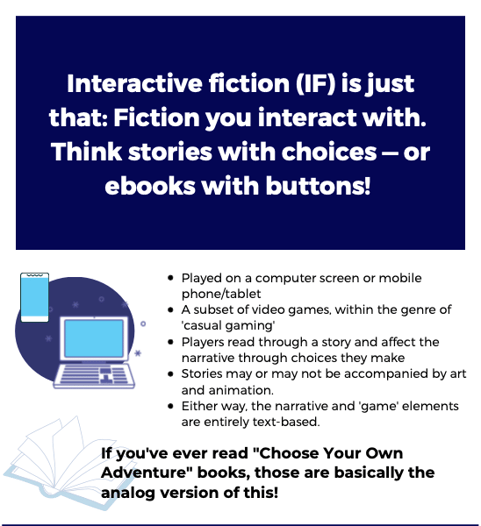
The roots of interactive fiction go deep. Choose Your Own Adventure books were many readers' first taste of the form, and text-based computer games like Zork and Colossal Cave Adventure were doing something similar in the 1970s and 80s. Today the genre is thriving; major interactive fiction platforms have tens of millions of monthly users, and the tools available to writers have never been more accessible.
The spectrum is wide. Interactive fiction can be a simple story with two possible endings or a sprawling epic with hundreds of branching paths. It can be dark and literary or funny and absurd. It can take twenty minutes to read or twenty hours. What it always is, at its core, is a story that responds to the reader.
Before you write a word, play a little. The genre is wider than most people expect, and experiencing a few different styles will do more for your instincts than any amount of reading about them. Photopia by Adam Cadre is a short, emotionally powerful classic; if you want to understand why people love interactive fiction, start there.
For something completely different, Choice of the Dragon by Choice of Games is the game that launched the entire ChoiceScript platform — you play as a fire-breathing dragon terrorizing a kingdom, and it's a great intro to the stat-tracking, character-building style that choice-based fiction does so well. And if you want to see what Twine can do that no other medium can, Queers in Love at the End of the World by Anna Anthropy takes about ten seconds to play; there is literally a countdown timer, and that constraint is the whole point. All three are completely free and playable right in your browser.
Go play. Come back. Now let's write.
How Interactive Fiction Is Different from Linear Storytelling
The most important mental shift you need to make is to know that you are still writing a story; you just have a new element to write. With a novel, a film, a play, you write the setting, the characters, the plot. In interactive fiction, you have all of that, plus one more: the player themselves. The reader isn't just following your protagonist through the story; they are the protagonist, and that means they're part of the story you're writing. Your job is to write a world that accounts for them, that responds to them, that makes them feel like their presence in the story was always part of the design. That's what makes interactive fiction an experience, not just a narrative.
In linear fiction, you (the writer) control everything. You decide what happens, in what order, and how the reader feels about it. Your job is to write well and trust the reader to follow.
In interactive fiction, your job is to build a possibility space; a world that responds, a story that listens. You're not writing one path. You're writing the conditions under which many paths can exist, and then making each of those paths feel intentional and alive. You’re writing something that allows the player to create alongside you, as they go.
This changes everything. It changes how you think about character (your protagonist has to feel consistent across choices the reader might make for them). It changes how you think about plot (you can't rely on one carefully engineered sequence of events). It changes how you think about consequences (every choice needs to land somewhere).
The payoff is incredible. When a reader makes a choice in your story and something actually changes because of it, they feel a kind of investment that linear fiction simply cannot replicate. They didn't just read what happened. They made it happen.
Start with Your Story, Not Your Structure
The most common mistake new interactive fiction writers make is jumping straight into mapping branches before they actually know their story. Don't do this. A beautifully complex branch structure built on a shaky foundation is still shaky.
Start with a character. Who is this person? What do they want more than anything? What is standing in their way? What are they afraid of? What are they wrong about?
Start with a world. What does this place look, sound, and smell like? What are the rules here: social, physical, magical? What does the reader need to understand to feel grounded?
Start with a voice. How does this story sound? Is it wry and dry? Urgent and breathless? Lyrical? Funny? The voice of your narrative shapes every single line, so know it before you write one.
A note on point of view. Second person ("you walk into the room," "you hesitate before answering") is the dominant convention in interactive fiction, and for good reason. It collapses the distance between reader and character and makes every choice feel immediate and personal. When you write in second person, the reader doesn't observe the protagonist making a decision. They make it.
That said, second person is not required. Interactive fiction has been written effectively in every POV, and you should use the one that serves your story best.
- Second person: immersive, immediate, and expected in the genre. Can occasionally feel forced in longer works, particularly when the character has a very specific personality the reader might not feel connected to.
- First person: creates a strong, distinct narrator voice. Works beautifully for character-driven stories where the protagonist's interiority is the whole point. Slightly unusual in IF, which means it can feel fresh and distinctive when done well.
- Third person: creates more distance between reader and character; the reader feels more like a director than a protagonist. Works well for ensemble casts, political or strategic stories, or narratives where an observational perspective enriches the experience.
Pick the POV that fits your story. Just be intentional. The worst thing you can do is default to second person without thinking about whether it's actually right for what you're writing.
Planning Your Branches (Without Getting Lost)
Here is a thing that happens to almost every first-time interactive fiction writer: they start branching enthusiastically, follow every thread to its conclusion, and end up with several hundred scenes and no idea how to finish. This is called combinatorial explosion, and it will end you if you let it.
The solution is knowing your structure before you write a single branch. Here are three tried-and-true structures used by interactive fiction writers at every level:
String of Pearls. The story is mostly linear; there is a strong central through-line that pulls the reader forward. Along the way, small branch moments let readers explore, make flavor choices, or take brief detours before returning to the main path. Think of each major story beat as a "pearl" and the narrative connecting them as the "string." The reader always arrives at the same key moments; the journey between them can vary. This structure is great for writers who love a strong central story and want just enough interactivity to give readers a sense of agency without exploding the scope of the project.
Hub and Spoke. The story returns repeatedly to a central "hub" scene or location, and from there the reader chooses which "spoke" to explore. Chapters or subplots can be experienced in variable order before everyone converges again. This is a natural fit for mysteries (interview suspects in any order you like), ensemble stories, investigation narratives, or any story where the reader should feel free to roam without the writer having to account for infinite permutations. The key craft challenge here is making sure each spoke feels equally worthwhile no matter which order the reader encounters them.
The Diamond (Branch and Bottleneck). The story branches meaningfully at key choice points, but those branches converge back together at critical narrative moments before branching again, like a series of diamonds along a line. Choices feel significant and the world feels genuinely responsive, but the writer maintains control of the major beats that everyone experiences. This is arguably the most practical structure for writers new to IF, and it's the engine behind most Telltale-style games and a huge percentage of successful choice-based fiction. If you're not sure which structure to use, start here.
A practical tip: map your structure before you write. Identify your convergence points first. Don't branch until you know how you're going to merge back.
Writing Choices That Actually Feel Like Choices
A lot of interactive fiction falls apart not in the structure, but in the moment-to-moment experience of choosing.
Context is everything. Before a reader can make a meaningful choice, they need to understand what they're choosing. If a choice arrives without enough setup, readers don't feel empowered; they feel lost. Confusion and frustration in interactive fiction almost always trace back to an under-contextualized choice. Give readers the information they need to feel the weight of the decision before they have to make it.
Give readers a choice early. One of the most effective things you can do in interactive fiction is put a choice in front of the reader within the first few moments of the story. It doesn't have to be a big, consequential decision; even something small works. What it does is immediately signal: this world responds to you. You're not just reading. You're in it. That early buy-in pays dividends throughout the entire experience.
Good choices reflect values, not just tactics. The least interesting choices in interactive fiction are the strategic ones ("take the sword or take the shield"). The most interesting ones are the human ones ("tell your sister the truth or protect her from it"). Choices that ask readers to reveal something about who they are, or who they want their character to be, create investment. Not every choice needs to be this weighty; variety matters. But the choices readers remember are the ones that felt like they meant something about character.
Every choice needs a consequence. This applies even to choices that don't actually fork the narrative. If a reader chooses to comfort a grieving character and the story continues without a single acknowledgment of that moment, they will feel cheated. Consequences don't have to be dramatic; a line of dialogue that reflects the player's choice, a shift in tone, a small detail that echoes later. Something must land. Choices that feel consequential build trust. Choices that feel hollow break it.
Some of the best choices don't change the plot at all. There's a category of choice in interactive fiction that is purely expressive; it doesn't fork the narrative, it doesn't unlock a different ending, it just asks the reader to say something true. "Do you forgive him?" might lead to the same next scene either way. But the reader needed to answer that question, and the story acknowledging their answer makes them feel seen. These choices are incredibly powerful; just make sure the narrative always reflects back what the player chose, even if the path forward is the same.
The number of options is a craft decision. Two choices creates a dramatic dilemma. Three choices is a great sweet spot for flow. Four or more can overwhelm readers and dilute the sense that any single option matters. Think carefully about how many options each moment actually needs; more is not always more.
And sometimes, one option is exactly right. A single prompt ("Continue.") isn't a failure of interactivity; it's a rhythmic tool. It lets the reader set the pace and signal readiness before something significant happens. Think about the way a paragraph break, a page turn, or a chapter ending creates rhythm and anticipation in a traditional book. A single-option choice does the same thing in interactive fiction. Use it intentionally; before a revelation, after an emotionally heavy moment, at the threshold of something new.
Keeping Your Reader Engaged Across Every Path
Once your branches exist, your job is to make every single one of them feel like a complete and satisfying experience; not like a lesser version of some imagined "main path."
Pacing. Interactive fiction has unique pacing challenges because readers move through different content at different speeds and via different routes. Keep individual scenes tight. A reader who chose a particular path shouldn't have to wade through three paragraphs of setup to get to the thing they came for.
Acknowledge the past. Whenever you can, let the text reflect what the reader has chosen. A character who remembers something the player did two scenes ago; a description that changes subtly based on an earlier decision; a callback to a choice the reader probably thought didn't matter. These moments are worth ten times their word count in reader trust and engagement.
Tension at every choice point. Choices should arrive at moments of real stakes. If readers are choosing between two calm, consequence-free options, they'll stop caring. Let choices arrive when something is actually on the line.
Love every path equally. Writers tend to have a "true path" in their heads; the one they wrote first, the one that feels most like the story they meant to tell. The other branches can feel like obligations. Resist this. Readers exploring a secondary path deserve prose written with just as much care as the primary one. If you don't love a branch, neither will they.
Choosing the Right Tool for the Job
There are a lot of great tools out there for writing interactive fiction, and each have strengths and weaknesses. There are so many more than we could include in this one post, but here’s an overview of some commonly used options:
Twine (free, open-source) is the most popular interactive fiction tool in the world, and for good reason. It gives you a visual, node-based map of your story as you build it, which is enormously helpful for keeping track of branches. Even for basic use you'll need to pick up some Twine-specific syntax and logic — it's not steep, and there are excellent tutorials everywhere, but there is a learning curve. It also has no built-in publishing or distribution platform, so getting your finished story in front of readers requires some extra steps.
Ink/Inky (free, by Inkle Studios) is the tool used to write professional games including 80 Days and Heaven's Vault. It's a scripting language designed specifically for writers, and it handles complex variables and state tracking more elegantly than Twine. If you want to eventually integrate your story into a larger game built in Unity, Ink is the natural bridge. The tradeoff is that there's a scripting language to learn; it's not that steep, but it's not zero.
ChoiceScript (free, by Choice of Games) was built specifically for choice-based fiction with a focus on character stats and branching storylines. It's considered one of the most beginner-friendly scripting options out there, and if your game gets accepted to the Choice of Games platform, you get a built-in publishing path and revenue share. The limitations are that the output format is less visually customizable than Twine, and writing for the platform means working within their content and format guidelines.
Articy:Draft (paid) is the industry-standard tool for professional game studios working on large, complex narrative games; it's what I used at Soma Games before starting Iffly. It is genuinely powerful for teams managing huge amounts of branching content, dialogue trees, and character flows. For a solo writer building a text-based interactive story, though, it's overkill; expensive, steep to learn, and designed for game development teams rather than writers.
Iffly (that's us!) was built specifically because none of the above tools were built for writers first. There is no code, no syntax, no scripting language to learn, no learning curve at all. You open it, you type, you use keyboard commands, and you build a fully interactive text-based game. That's the whole thing. It's the only tool on the market with no programming language whatsoever; we have the patent to prove it (U.S. Patent 12,130,868, not that we're proud or anything!). And once your story is done, Iffly is also a publishing platform; you can publish and sell your game with one click, no extra steps, no separate distribution puzzle to solve. If you just want to write, without any of the technical overhead, try it free at iffly.co.
Your First Interactive Story: Where to Start Today
Whatever you do: don't wait until your idea is perfect.
Start small. A single character. One meaningful choice point. Two paths that converge at the end. Something you can finish in a few sessions and actually share with someone. That first story will teach you more about interactive fiction than any guide, including this one.
The real skills of interactive fiction writing — knowing when to branch, how to contextualize a choice, how to make every path feel loved — are learned by doing. You will make mistakes. Your first story will be rougher than you imagine it right now. That is completely fine. Every writer who has ever published an interactive story started exactly where you are: one choice, one branch, one reader.
The medium is wide open. The only way in is to start writing.
Try Iffly free at iffly.co and write your first interactive story today.